Yes. Thai passport holders need a visa for Bhutan, and so does almost everyone else. It costs USD 40 per person, is applied for online before you fly, and takes about five working days. There is no visa-free entry and no visa on arrival. The application is filed by a licensed operator alongside your Sustainable Development Fee, against a confirmed itinerary.
That last point is the one that surprises people: you cannot submit a Bhutan visa application on your own behalf the way you would an Indian or Japanese e-visa. It is bound to a booking. This guide covers what that means in practice, what documents you need, what actually arrives before departure, and the two traps — passport validity and Indian transit — that cause almost every problem we see. Checked against the Department of Tourism in August 2026.
Do Thai passport holders need a Bhutan visa?
Yes, and the rule is simpler than most countries' because there are so few exceptions.
Every international visitor requires a visa in advance, whatever their nationality, with one meaningful exception: Indian nationals, who enter under a separate permit arrangement rather than the tourist visa, and pay the regional SDF rate of Nu. 1,200 per person per night instead of USD 100. Bangladeshi and Maldivian nationals have historically had their own arrangements as well. If you hold a Thai, British, Australian, Singaporean, American, Japanese or any other passport, you are in the ordinary category and you need the USD 40 visa.
There is no distinction by purpose for tourism: a five-night holiday and a two-week trek use the same visa.
How much is the Bhutan visa, and how long does it take?
USD 40 per person, one time, non-refundable. Children need their own visa at the same price; there is no family application and no child discount on the visa, unlike the SDF.
Processing takes about five working days once a complete application is filed. In practice we build in longer, because the clock starts when the application is complete and not when you first send us your dates — and because five working days across a Bhutanese public holiday is not five calendar days.
The fee is non-refundable if you cancel, and it is non-refundable if the application is refused. This is rare for ordinary tourism, but it is a reason not to file before your plans are firm.
What documents do you need?
Less than you expect. There is no interview, no bank statement, and no employment letter.
- A clear colour scan of your passport bio page. The photo page, readable, not a photograph of a screen.
- A passport-style digital photograph.
- Your passport valid for at least six months beyond your date of entry. This is the single most common reason an otherwise fine application stalls.
- Travel insurance covering your stay. Carry the certificate. Cover including medical evacuation is the sensible standard given the road distances.
- A confirmed itinerary through a licensed operator, which is the part we handle.
Names must match the passport exactly. A middle name recorded on the booking but not in the passport, or a married name on one and a maiden name on the other, will hold the file up. Send us the passport scan rather than typing your details out and this problem disappears.
How do the visa and the SDF fit together?
They are one transaction, which is why people conflate them. They are not the same thing.
The visa is a USD 40 application fee for permission to enter. The SDF is a USD 100 per person per night levy for the time you spend in the country. Both are paid in advance, in the same filing, and neither can be paid at Paro on arrival.
For five nights, one adult, that is USD 40 plus USD 500, so USD 540 before flights. The full detail of how nights are counted and who pays less is in what Bhutan's Sustainable Development Fee actually costs, and the whole trip in baht is in how much a Bhutan trip really costs from Thailand.
What actually happens, step by step
The sequence matters, because each step depends on the one before it.
- You send dates and a party size. We hold flight seats. Nothing is payable at this point.
- We return a written quote covering flights, SDF, visa and land arrangements.
- You approve it and send passport scans and photographs.
- The operator files the visa application and remits the SDF against your confirmed itinerary.
- Visa clearance is issued, typically within about five working days.
- We ticket the flights and you receive the clearance letter with your documents.
- At Bangkok check-in, the airline verifies your clearance. Without it you are not accepted for the flight.
- At Paro, immigration issues the visa in your passport against the clearance letter.
Two useful implications. Because check-in verification happens in Bangkok, a problem with your clearance surfaces at Suvarnabhumi rather than in Bhutan — which is inconvenient but far better than the alternative. And because the visa is issued on arrival, your passport never leaves your possession during the process.
Do you need an Indian visa if you fly via Kolkata?
Sometimes, and this is the question that catches out more travellers than anything else on this route.
Some Bangkok–Paro services operate via Kolkata (CCU). If you remain in international transit and continue on the same ticket without clearing Indian immigration, an Indian visa is generally not required. If your routing requires you to clear immigration and re-check — because of a terminal change, an overnight, or a separately ticketed connection — then you need appropriate Indian entry permission, which for most nationalities means an Indian e-visa.
We will tell you which case applies to your specific flights in writing, because it depends on the routing and not on your nationality alone. Do not assume from a friend's trip: the same city pair can be either, depending on the flight numbers.
If you are combining Bhutan with a Bodh Gaya pilgrimage or a stop in Kolkata, you are firmly in the second case and you will need the Indian e-visa. Our step-by-step guide to the Indian e-visa covers that application, which you do file yourself.
Why can't you visit Bhutan independently?
Because the visa is issued against an itinerary, not against a person.
A licensed Bhutanese operator has to file your application, and the filing has to show where you will be and who is guiding you. There is no mechanism for an unguided tourist visa, which means backpacking Bhutan in the ordinary sense is not available — not as a matter of policing, but because there is no document that would permit it.
This is a deliberate feature of the High Value, Low Volume policy rather than an administrative accident, and it has a practical upside worth naming: the guide requirement is why a first visit works so well, and why Bhutan is as safe as it is. You are never trying to interpret a monastery's etiquette or a mountain road on your own.
What happens at Paro on arrival?
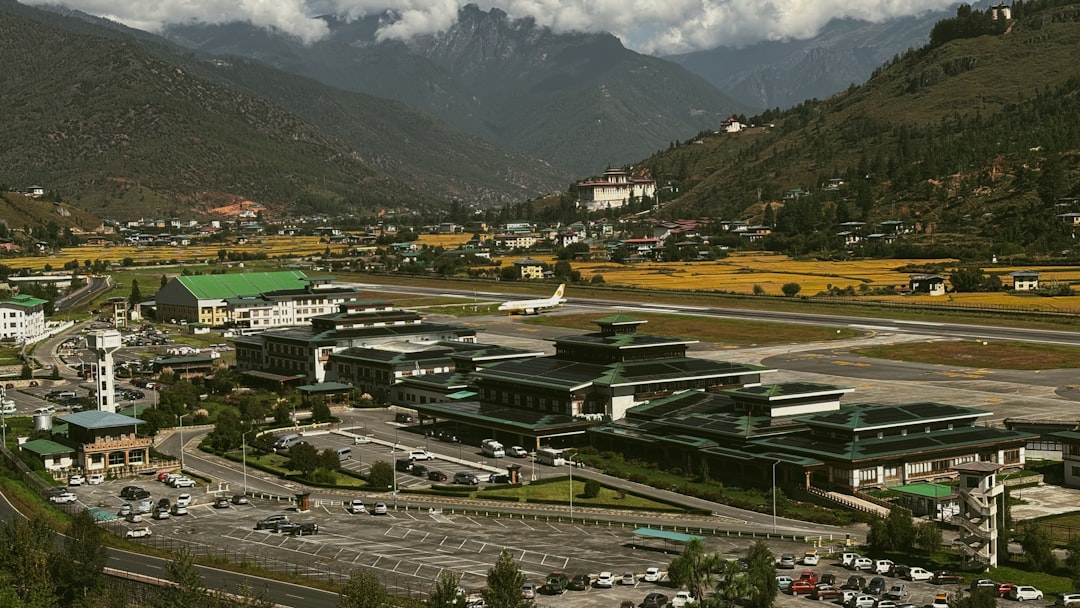
Less than the paperwork implies. You complete an arrival card on the aircraft, queue at immigration, and the officer matches your passport to the clearance already in the system and issues the visa into your passport. You are not asked to produce an SDF receipt; it is already recorded against your name.
Your guide meets you in the arrivals area with your itinerary. There is an exchange counter and, usually, a telecoms desk — though buying a SIM in town is generally easier, as our guide to SIMs and eSIMs in Bhutan explains. Total time from wheels down to leaving the terminal is normally well under an hour, because Paro handles few flights a day and yours is unlikely to overlap with another.
Is there a Bhutan e-visa you can apply for yourself?
Not for tourism. This is worth being precise about, because the word "e-visa" appears everywhere and means something different here.
The Bhutan tourist visa is applied for electronically and the clearance arrives electronically, so calling it an e-visa is not wrong. But the applicant is the licensed operator, not you. There is no traveller-facing portal where you enter your details, pay USD 40 and receive a visa, in the way India's e-visa system works.
The practical consequence is that any website offering to "get your Bhutan e-visa" for a service fee is a reseller placing the same booking you could place directly, with a margin on top. You are not buying faster processing, because processing time is set by the Department of Tourism and is the same for every operator.
The corollary is also worth knowing: if a site quotes you a Bhutan trip without asking for a full itinerary, it cannot yet file your visa, whatever the confirmation email says.
What does the visa actually permit?
It permits the itinerary that was filed, for the dates that were filed. That is narrower than a normal tourist visa and it matters in one specific way.
Travel beyond the Paro and Thimphu areas needs a route permit, arranged by your operator alongside the visa and checked at posts on the way. This is routine — the drive to Punakha over Dochula crosses one — and you will not queue for it yourself. But it is why an itinerary is not a suggestion: deciding on the road to add Phobjikha requires your guide to arrange the permit, not merely to change direction. Adding a valley is usually possible with notice, and rarely possible on the morning.
Certain monasteries and inner temple sanctums are closed to non-Buddhist visitors regardless of permits, and photography is restricted inside most temples. Neither is a visa question, but both surprise people who assumed a permit covers access.
Practically: build the trip you want at quote stage. The five-day, four-night Paro, Thimphu and Punakha itinerary is the standard shape, and adding to it is easy in advance and awkward later.
Anything specific to a Thai passport?
Three things come up often enough to name.
Transliteration. Thai names rendered in Latin script are not always consistent between an older passport, an insurance policy and a booking form. The visa is matched against the passport, so use the passport spelling everywhere, including on your insurance certificate.
Renewal timing. If your passport fails the six-month test, allow for the appointment and issue time before you commit to autumn dates. This is the most common reason a Thai traveller has to move a trip, and it is entirely avoidable by checking early.
Insurance bought in Thailand. Most Thai travel policies cover Bhutan without a rider, but not all include medical evacuation, which is the cover that actually matters here. Read the evacuation clause rather than the headline sum insured.
Health documents are straightforward: no vaccination certificate is required for entry from Thailand under normal conditions. Altitude, not disease, is the health issue to plan for, and how to acclimatise properly is the guide to read before you arrive.
What if the application is refused?
Refusal for ordinary tourism is rare enough that we have no useful pattern to report, and the fee is not refunded when it happens.
The realistic failure modes are administrative rather than substantive: an illegible passport scan, a name mismatch, insufficient passport validity, or an itinerary that has not been confirmed. All four are caught before filing if you send documents rather than typed details, which is why we ask for scans.
If clearance has not arrived and departure is close, the decision point is the flight, not the visa. Moving a ticket is possible; boarding without clearance is not.
Can you extend, change dates or re-enter?
Extending your stay is possible from inside Bhutan, filed as an amendment through your operator, with additional SDF for the additional nights. Raise it with your guide as early as you know.
Changing dates before travel means the clearance is reissued against the new itinerary. The USD 40 is not charged twice for a routine date change, but it is not refunded if you cancel outright.
Leaving and re-entering — for instance a side trip into India and back — needs to be declared in the original itinerary so the permission covers it. Deciding on it after arrival is much harder than planning it in.
What happens if you apply late?
The application does not become faster under pressure, so lateness costs you the flight rather than the visa.
Five working days is the working assumption, and the file is only complete when every passport scan is legible and every name matches. In high season, seats are the binding constraint anyway: on when to book Bangkok–Paro flights the honest answer is that October and Paro Tshechu sell out long before any visa deadline matters.
Our practical guidance is to have passport scans with us at least three weeks before departure for ordinary dates, and earlier for autumn and festival travel. That is not a policy, it is what leaves room for a passport that turns out to expire in four months.
Passport and document traps
Validity. Six months beyond entry, not beyond booking. Check the expiry date now, before you read any further, because renewing a Thai passport takes time you may not have budgeted.
Damage. A water-damaged bio page or a detached laminate causes problems at Paro immigration even with valid clearance.
Blank pages. You need space for the visa. If your passport is nearly full, renew it.
Dual nationality. Travel on the passport used for the visa application, throughout. Entering on the other one does not work.
Children's passports. Short validity is common, and a child's passport expiring five months after entry fails the same test as an adult's.
Mistakes we see most
Assuming Thai passports enter Bhutan freely. They do not. The confusion usually comes from Bhutan's regional arrangements for Indian nationals.
Trying to apply directly. There is no traveller-facing portal for the tourist visa. If a site offers you one for a fee, it is a reseller.
Treating the SDF as the visa fee. They are separate, and the SDF is far larger.
Ignoring the Kolkata transit question. Ask us; do not guess.
Booking a tight onward connection. The visa is not the risk here, the weather is. Paro closes for cloud and flights move. Leave a buffer night before any long-haul departure from Bangkok.
The simplest way to get your visa sorted
Send us your dates and party through Book & Hold. We hold your seats, return one written quote covering flights, SDF and visa, tell you exactly which documents to send and whether your routing needs Indian transit permission, and file the application once you approve.
Fares are quoted in Thai baht, per person, inclusive of taxes and surcharges at the time of publishing, and start from the figure shown. Fares, seats and availability are confirmed in writing by OMG Experience, the appointed General Sales Agent for Bhutan Airlines in Thailand, before ticketing. Nothing is payable online before you receive and approve the final quote.