Pack for a wide day rather than a cold country. A November day in Paro can start below freezing and reach 18°C by noon, so three layers — a base, a fleece or light down, and a waterproof shell — will serve you better than one heavy coat in every month except deep winter, when you want both.
Beyond that, two things drive the list: temples require covered shoulders and knees year-round, and the Tiger's Nest climb wants broken-in shoes with grip. Get those three right and the rest is detail.
Bhutan Airlines includes 25 kg of checked baggage and a hot meal on every fare from Bangkok, economy as well as business, so there is no allowance pressure pushing you to travel light. What you should resist is the opposite: a large case is genuinely awkward on Bhutanese roads and in older hotels.
What bag actually works?
A soft-sided case or duffel of 60 to 70 litres, plus a 20 to 30 litre daypack you can carry on the trail.
The daypack matters more than the main bag. It carries water, a layer, sun protection and a camera up to Taktsang, and it is the bag you will actually live out of. A hard shell case is fine at the airport and a nuisance on a gravel hotel forecourt or a farmhouse staircase.
Leave the tripod and the big camera bag if Taktsang is on your itinerary. Everything except water and a jacket goes into a locker at the monastery door regardless.
How should you dress for temples and dzongs?
This is not a suggestion, and getting it wrong means being turned away from the thing you travelled to see.
- Shoulders covered. No vests, no sleeveless tops, for men or women.
- Knees covered. Long trousers or a long skirt. Shorts are not acceptable inside.
- Shoes off in shrine rooms, so wear something that comes off without sitting down. Slip-on shoes and socks you are happy to be seen in.
- Hats off indoors.
- No photography inside most temples, including Taktsang. Assume not, and ask.
One collared shirt or a smart top is worth packing. Dzongs are working government and religious buildings, and Bhutanese visitors dress properly for them; matching that is straightforward courtesy rather than a rule you will be tested on.
What do you need season by season?
Bhutan's daily range is wider than its seasonal range, so the layers do not change much — the outer layer does.
October to November, and March to May. The core case. Base layer, fleece or light down, waterproof shell, long trousers, one warm hat, thin gloves for early mornings on a pass. Days are mild, mornings and evenings are cold.
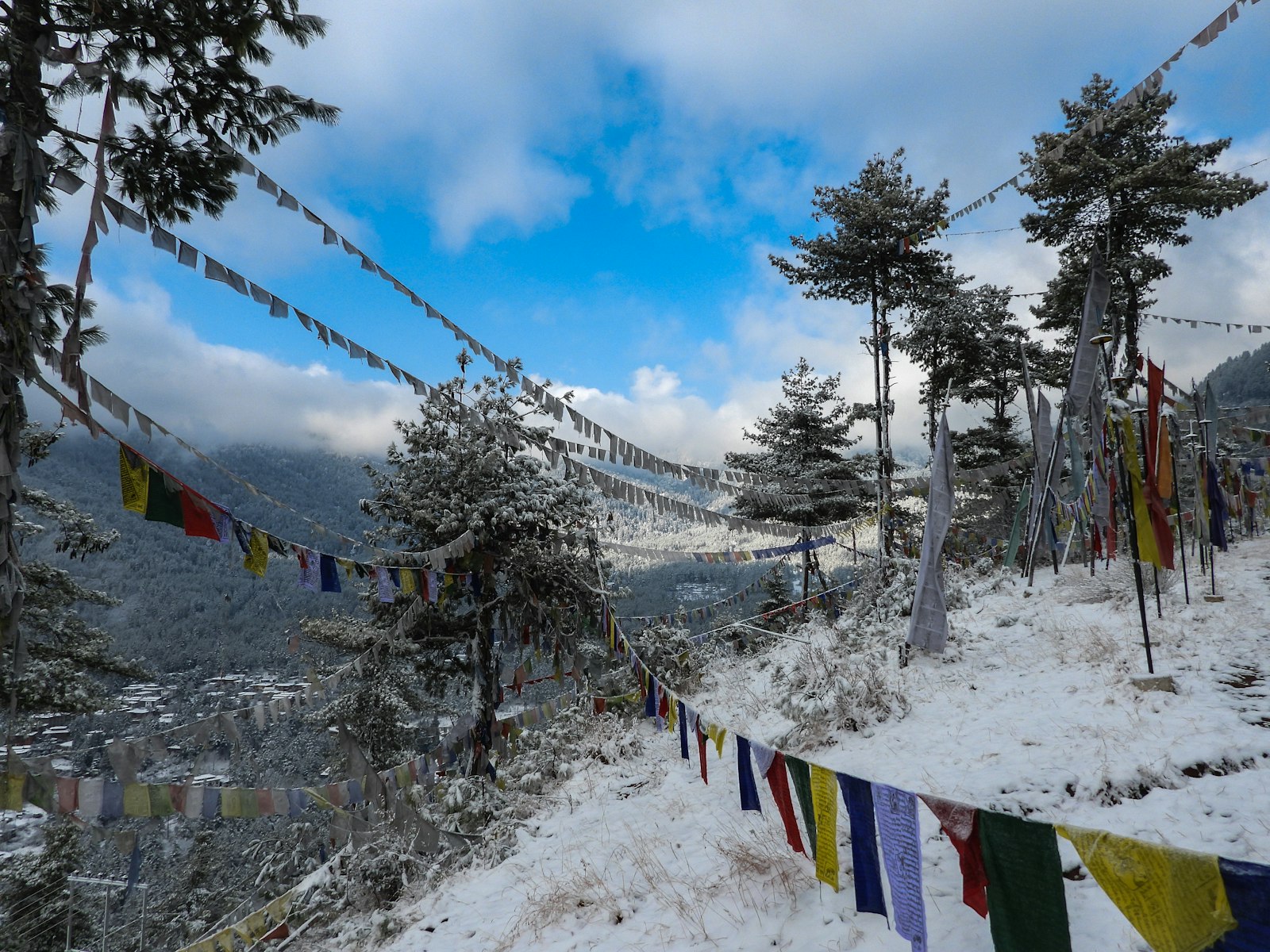
December to February. Add a proper insulated jacket, a warmer hat, thicker gloves and thermal base layers. Nights fall well below freezing at altitude, and dzong interiors are unheated stone. If your itinerary sleeps at Punakha, around 1,200 m, you will be considerably warmer than the Paro nights suggest.
June to August. The monsoon. A genuinely waterproof shell rather than a shower-resistant one, quick-drying trousers, sandals for the evening, and a dry bag or waterproof liner for your camera and documents. Trails are muddy and forest sections carry leeches, so long socks and closed shoes matter more than usual. Expect warm days, 20 to 25°C in Paro, and pack lighter layers than you would in autumn.
Which season to choose in the first place is a separate question, covered in the month-by-month guide to visiting Bhutan.
What should you wear for the Tiger's Nest climb?
The climb is about 900 m of ascent to roughly 3,120 m, so this is the one item on the list where a poor choice hurts.
Shoes: trail shoes or light boots with real grip, worn in over at least two or three long walks beforehand. The final section is around 100 m of uneven stone steps down into a gorge and back up, and smooth-soled trainers are the wrong tool for it.
Layers: cold at the car park at dawn, warm on the climb by mid-morning, cold again in the shade of the gorge.
Carry: one to one and a half litres of water, sun hat, sunglasses, sunscreen, snacks, a light shell, and a walking pole if your knees have views. Sun at 3,000 m burns faster than Bangkok sun through thinner air.
The full stage-by-stage picture is in the guide to hiking Tiger's Nest.
What is easy to forget?
The items people wish they had brought, in rough order of regret.
- A power bank. Cold drains phone batteries, and you will be photographing more than usual.
- Lip balm and hand cream. Dry mountain air, especially in winter.
- High-SPF sunscreen. Thin air, strong sun, and a false sense of security because the temperature is mild.
- Any prescription medication, in your cabin bag, always. Pharmacies outside Thimphu are limited.
- Rehydration sachets and simple painkillers. Altitude headaches respond well to water and paracetamol; see how to acclimatise in Bhutan.
- Cash in ngultrum or US dollars. Card acceptance is thin outside Thimphu and Paro hotels, and ATMs run dry on festival weekends — how money works in Bhutan.
- A universal adapter. Bhutan uses Indian-style round-pin sockets at 230 V, so a Thai two-pin plug will not always fit.
- A reusable water bottle. Practical, and single-use plastic is discouraged.
- A small torch. Monastery interiors are dark and rural power is not always steady.
What should you leave at home?
- A drone, unless you have specific written permission. Do not assume; assume the opposite.
- Anything sleeveless or above the knee as your only option for temple days.
- New footwear.
- A hard-sided case larger than you can lift, for the road and stair reasons above.
- Tobacco in quantity. Bhutan restricts tobacco sales and import, and personal allowances are limited and dutiable. Check before you pack it.
What about SIM cards and connectivity?
Not a packing item so much as a decision to make before you land: whether to buy a local SIM, use an eSIM, or rely on hotel wifi. All three work, with real differences in coverage once you leave the western valleys. Our guide to SIMs and eSIMs in Bhutan covers which is right for a short trip.
If you are taking an eSIM, set it up before you fly. Activation is easier on a connection you already have.
What paperwork should you carry?
Less than you would expect, and all of it in your cabin bag rather than the case.
Your passport needs six months of validity beyond travel and at least two blank pages, because the visa is stamped in on arrival. You do not need to print the visa clearance — immigration works from the record in the system — but a photograph of it on your phone costs nothing and has settled a check-in desk question more than once.
Carry your travel insurance certificate with the policy number and the emergency line, in a form you can read without data. Bhutan does not require proof of insurance at the border, but the one time you want it is the one time you have no signal.
A printed itinerary with your hotel names and your guide's phone number is worth the sheet of paper. Bring any prescription in its labelled packaging, with a copy of the prescription itself if it is something a customs officer might reasonably query.
If you are on a group departure, bring the booking reference rather than relying on the screenshot buried in your messages.
How much of this can you buy in Bhutan?
Enough that forgetting something is inconvenient rather than serious — with three exceptions.
Thimphu has supermarkets, pharmacies and a genuine outdoor shop or two. Sunscreen, batteries, a cheap fleece, painkillers, toothpaste and an adapter are all obtainable there and usually in Paro town as well. Prices are higher than Bangkok and choice is narrow, but the shelf is not empty.
The exceptions are footwear, because buying and breaking in trail shoes in the two days before Taktsang does not work; prescription medication, because specific brands are not stocked; and anything you need on day one, because your first afternoon is the valley itinerary rather than a shopping trip.
Contact lens solution, a specific camera battery, and high-SPF sunscreen in a factor above 30 are the three items most often reported as harder to find than expected.
What about gifts, and what can you bring home?
Small gifts are a kind gesture at a farmhouse stay, and pens, notebooks or good Thai snacks travel well. Avoid giving money to children, which local guides discourage for good reasons.
Coming home, textiles are the honest buy — kira and gho fabric, woven belts, raw silk — and the good pieces are expensive because they take months on a loom. Handmade paper, incense, and beaten-metal work are all genuine. Antiques and religious artefacts cannot be exported without a clearance certificate, and this is enforced at Paro on departure, so buy from a shop that can document the piece.
Leave room in the case rather than buying a second bag at the airport, which is more expensive than it sounds.
Once your list is sorted
Send your dates through Book & Hold and we will hold seats and return one written quote covering flights, SDF and visa, with your baggage allowance confirmed.
Fares are quoted in Thai baht, per person, inclusive of taxes and surcharges at the time of publishing, and start from the figure shown. Fares, seats and availability are confirmed in writing by OMG Experience, the appointed General Sales Agent for Bhutan Airlines in Thailand, before ticketing.