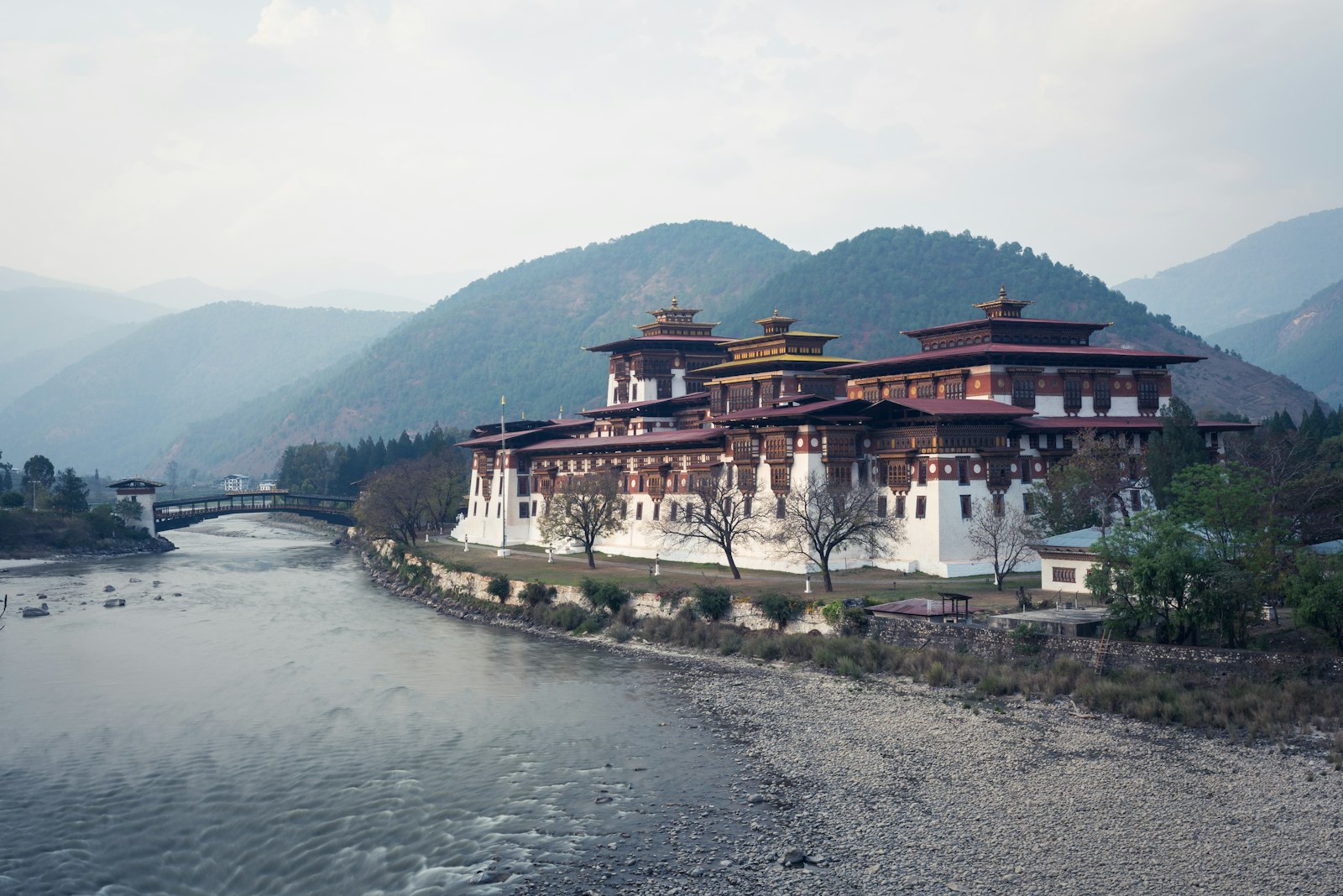
Punakha Dzong sits on the spit of land where the Pho Chhu and Mo Chhu rivers meet, at about 1,200 m — a full kilometre lower than Paro. That drop is the first thing you notice: it is warmer, the air is thicker, and the third night of a first trip is where most people finally sleep properly.
The dzong and the pedestrian suspension bridge downstream are a half-day together. Both are reached on the drive from Thimphu over Dochula pass at roughly 3,100 m, which is a morning in itself.
Why does Punakha feel different?
Altitude and history, in that order.
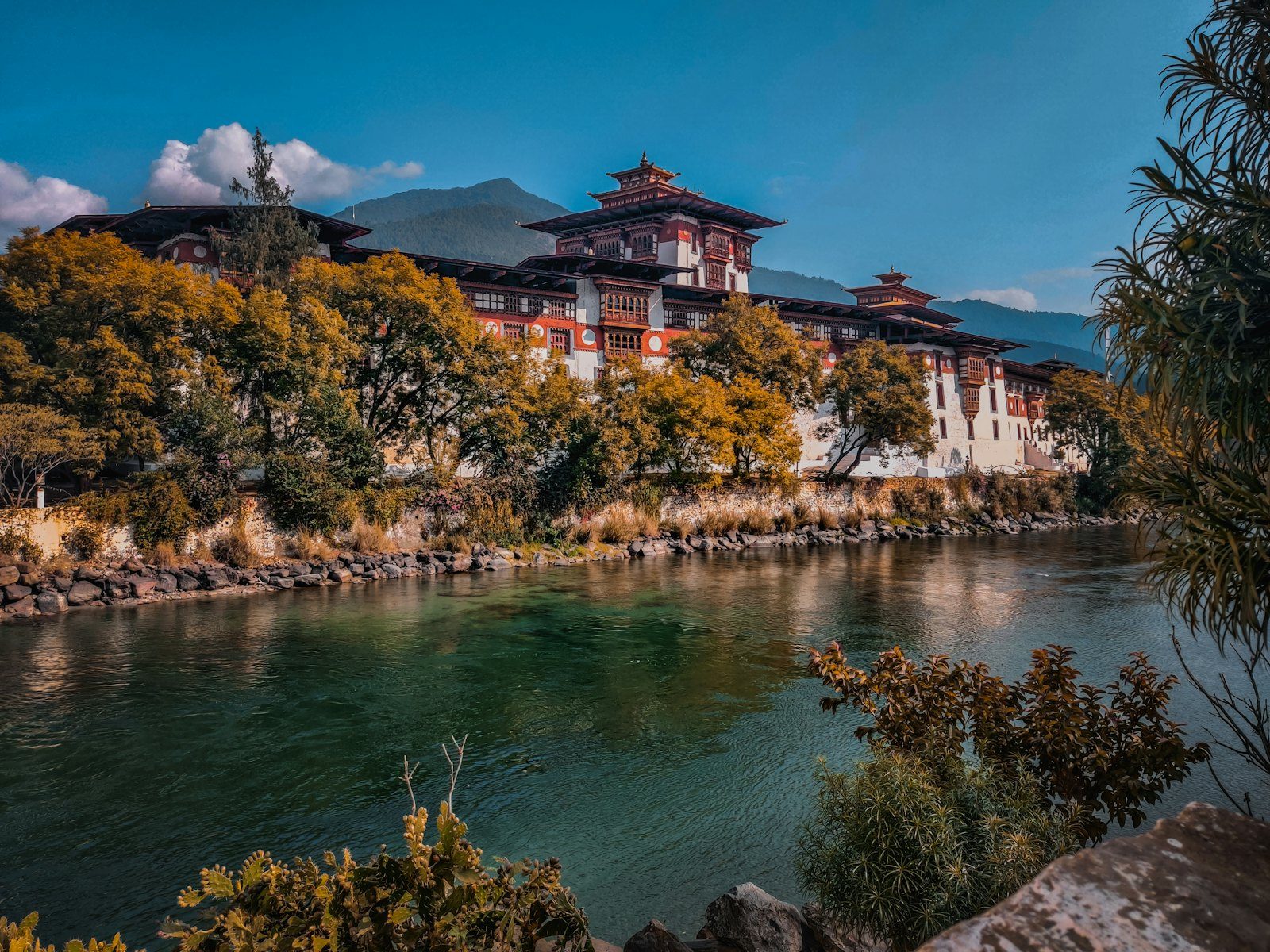
At 1,200 m the valley is subtropical rather than alpine. Rice grows on the terraces, there are banana and orange trees, and the temperature can be 10°C above what you left in Thimphu that morning. Travellers who have spent two nights at 2,300 m arrive and immediately want to sit outside.
Punakha was also Bhutan's capital until 1955, and its dzong remains the winter residence of the Je Khenpo, the country's chief abbot, and the central monk body who move down from Thimphu when the capital gets cold. So this is not a preserved monument. It is a working religious and administrative building that happens to be four hundred years old.
What is Punakha Dzong?
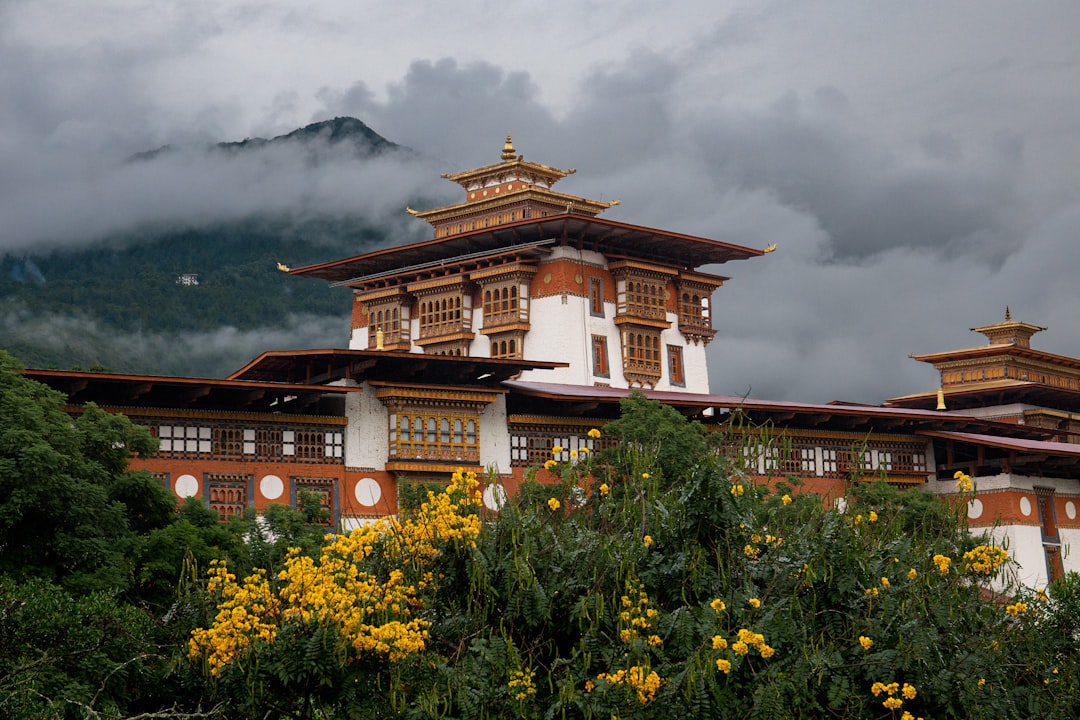
Pungthang Dechen Phodrang — the palace of great bliss — was built in 1637 by Zhabdrung Ngawang Namgyal, the figure who unified Bhutan, on a site chosen according to prophecy. It is the country's second-oldest and, by most accounts, its most beautiful dzong.
The building has survived fire, earthquake and glacial flooding more than once, and the current condition reflects a major restoration. It holds some of Bhutan's most important relics, including the Rangjung Kharsapani, and it was where the first king was crowned in 1907 and where the current king married in 2011.
Architecturally it is the classic form done at full scale: whitewashed walls with a red band, a central utse tower, three courtyards on descending levels, and a covered cantilever bridge across the Mo Chhu at the entrance. It is built without nails and without architectural drawings, which is worth knowing while you are standing under it.
What do you actually see inside?
You cross the wooden bridge, climb a steep flight of stone steps designed to be defensible, and pass through into the first courtyard.
The three courtyards descend in importance: the outer one is administrative, the middle monastic, and the inner holds the main temple. Along the way there are enormous prayer wheels, a bodhi tree, and murals that reward a slow look rather than a photograph.
The hundred-pillar assembly hall in the innermost courtyard is the one to stand still in. The interior is dark, the murals are eighteenth and nineteenth century, and the scale of the gilded Buddha, Guru Rinpoche and Zhabdrung figures is difficult to convey afterwards.
There is normally no photography inside temple rooms — assume not, and ask outside. The courtyards are where the photographs come from anyway.
What should you wear, and what are the rules?
The same rules as every dzong, and they are enforced here because it is a working institution.
- Shoulders and knees covered. No vests, no shorts, for anyone.
- Shoes off at the inner shrine. Wear something you can remove standing up.
- Hats off indoors.
- Walk clockwise around temple interiors and prayer wheels.
- Ask before photographing monks, and accept a no gracefully.
A collared shirt or a smart top is worth having in the bag. Bhutanese visitors dress properly for a dzong and matching that is straightforward courtesy. The packing list has the seasonal detail.
What is the suspension bridge like?
A long footbridge across the Pho Chhu about a fifteen-minute drive downstream from the dzong, hung with prayer flags and among the longest in the country at somewhere over 160 m.
It moves. Not alarmingly, but enough that people stop halfway to reconsider, and enough that you should hold a small child's hand if the wind picks up. The floor is planked and sound, the view back up to the dzong is the reason to cross, and the far side opens onto farmland and a footpath.
Twenty minutes covers it. This is a stop on the same morning as the dzong rather than a separate outing, and anyone who tells you it needs its own half-day is padding an itinerary.
What else is in the valley?
Chimi Lhakhang, a twenty-minute walk up through rice fields from the road, built in 1499 and associated with Drukpa Kunley, the so-called Divine Madman. It is a fertility temple, the iconography is frank about it, and the walk through the fields is as good as the destination.
Khamsum Yulley Namgyal Chorten, an hour's walk up the Mo Chhu valley, newer and less visited, with the best valley view in Punakha from its top floor.
River rafting on the Mo Chhu, a gentle two-hour float with the dzong at the end of it. Genuinely good, weather and water level permitting, and worth asking about at quote stage rather than on the day.
The rice terraces themselves, which are the reason the valley looks the way it does, and best in late September and October when the crop is gold.
What is the drive over Dochula like?
The best two and a half hours of the itinerary, and worth treating as part of the day rather than transit.
From Thimphu the road climbs steadily through pine and rhododendron to Dochula at roughly 3,100 m, where the 108 Druk Wangyal Chortens stand in ranks built in memory of Bhutanese soldiers. On a clear morning the eastern Himalaya lines the horizon behind them, including Gangkhar Puensum, the highest unclimbed mountain in the world. There is a café, a temple above the chortens, and prayer flags in every direction.
Cloud builds through the day, so the view is a morning proposition. Leave Thimphu early and the pass is worth forty minutes; leave after ten and you may be standing in a white room.
From the pass the road drops for about ninety minutes through changing vegetation — conifer to broadleaf to banana — which is the clearest demonstration you will get of what a kilometre of altitude means in the Himalaya. It is also where motion sickness arrives, so take something before the climb rather than during the descent.
When is the best time to come?
Spring for the jacaranda, autumn for the drive.
In late spring the jacaranda trees around the dzong turn the lawns lilac, and it is the photograph the valley is known for. Bloom timing shifts by a couple of weeks each year and we will not invent a date on a quote — we tell you what the season usually does and confirm nothing we cannot.
Autumn gives the clearest crossing of Dochula, with the eastern Himalaya on the horizon, and gold in the rice terraces. Winter is warm here compared with the rest of the country and is the best-value season. The monsoon is green, humid and low season, and the dzong under cloud is a photograph of its own.
The month-by-month guide to visiting Bhutan sets out the trade-offs properly.
How long do you need, and where do you stay?
One night is the standard and it is enough for the dzong, the bridge and one walk. Two nights turn Punakha into the rest day of the trip, which on a six-night itinerary is the single best use of the extra night after a second Paro night.
Hotels sit mostly on the valley sides above the river rather than in a town centre, because there is not much of a town centre — Khuruthang, the small commercial settlement, is functional rather than a place to spend an evening. That means your hotel is where you eat, and a room with a valley view is worth asking for specifically.
The valley is warm enough that air conditioning matters here in a way it does not in Paro, and cheap enough in low season that the tier above your usual is often affordable. If you want the luxury lodges, Punakha has two of the best in the country and they book out early for spring and autumn.
How does it fit into a first trip?
Night three of a five-day circuit, and the sequence matters. Land in Paro, sleep two nights, spend a night in Thimphu, then drive over Dochula to Punakha, then back to Paro for the Tiger's Nest climb.
Putting Punakha immediately before the Taktsang day is not an accident. A night at 1,200 m after two at 2,300 m is a genuine recovery, and it is why people who follow this order find the climb easier than they expected. The five-day, four-night circuit sets it out, and how to acclimatise explains why.
What does not work is Punakha and Taktsang on the same day. It is three hours of mountain road and a 900 m climb, and something has to give.
Hold your dates
Send your dates through Book & Hold. We hold your seats and return one written quote covering flights, SDF and visa, with the Punakha night placed where it does you the most good.
Fares are quoted in Thai baht, per person, inclusive of taxes and surcharges at the time of publishing, and start from the figure shown. Fares, seats and availability are confirmed in writing by OMG Experience, the appointed General Sales Agent for Bhutan Airlines in Thailand, before ticketing.