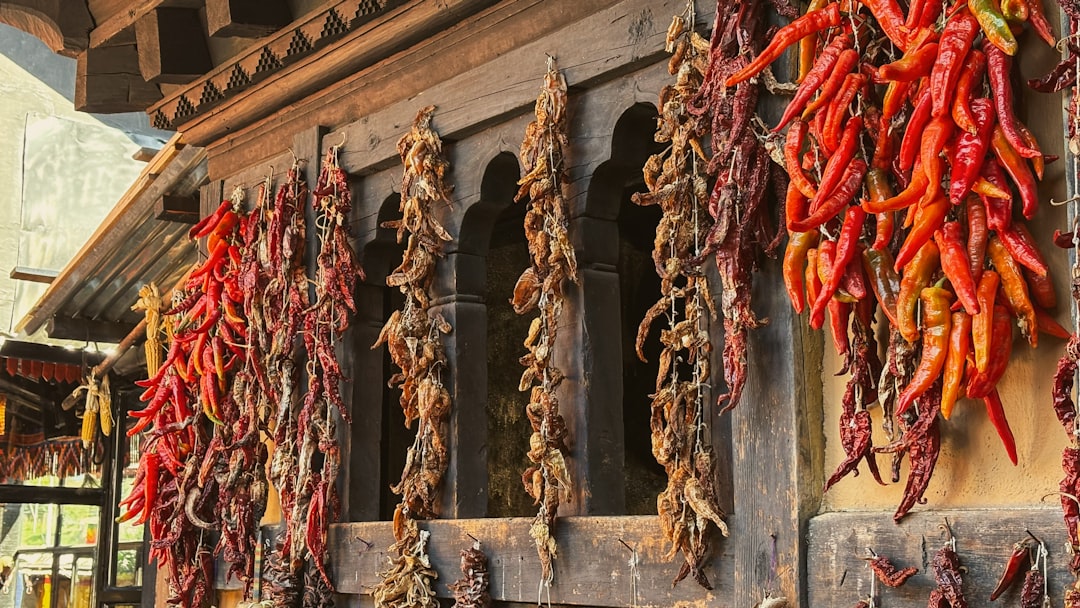
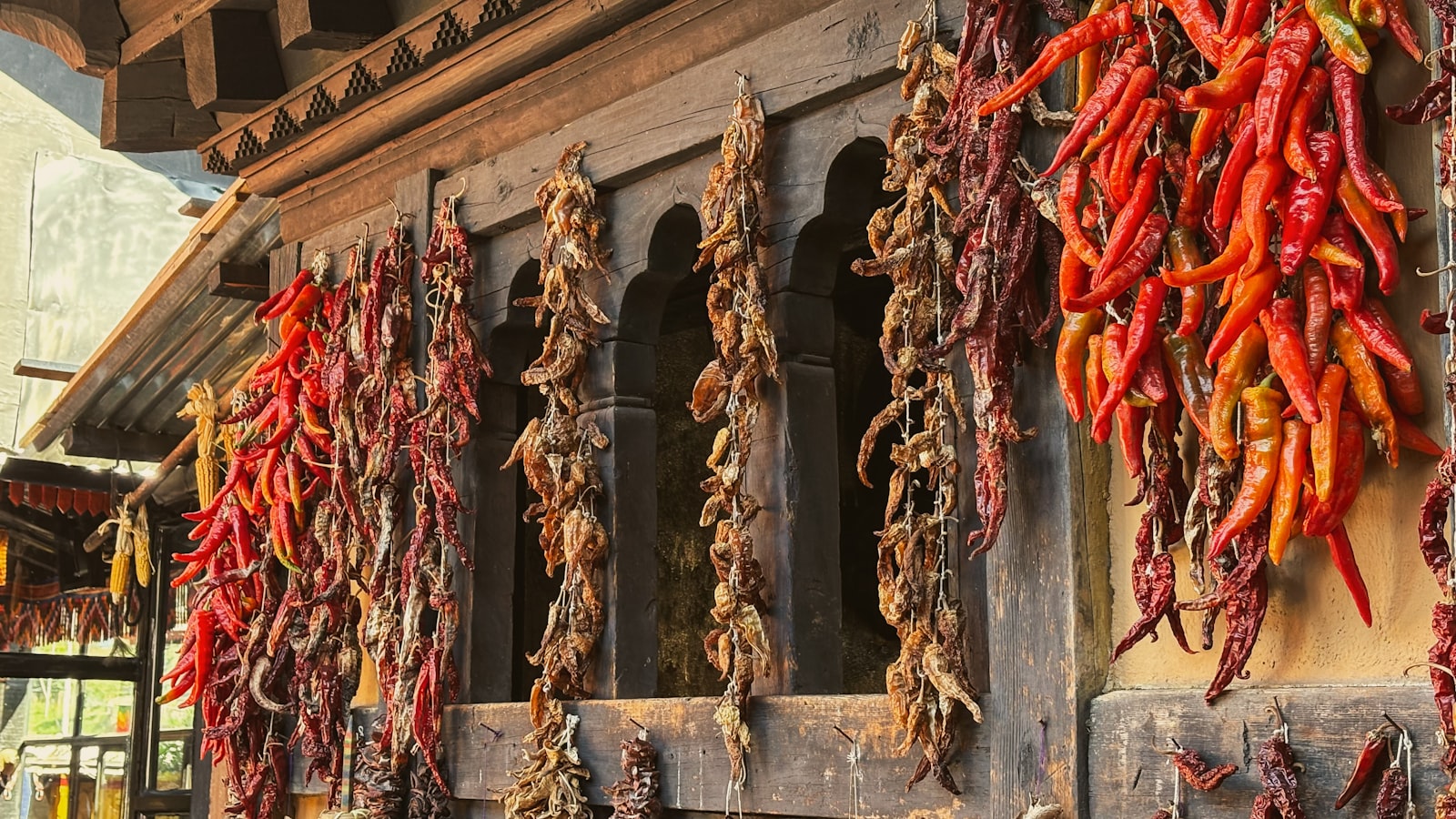
Ema datshi is chillies cooked in cheese, and it is a main course. That single fact explains most of Bhutanese food: chilli here is treated as a vegetable rather than a seasoning, and cheese made from cow or yak milk is the sauce that carries it. Around that sit red rice, buckwheat, potatoes, dried meat and dumplings.
The reputation for extreme heat is half true. It is genuinely hot by European standards and manageable by Thai ones, and every kitchen will make a mild version if you say so — ideally before the trip is written rather than as the bowl arrives.
What is on the everyday plate?
A Bhutanese meal is served all at once, family style, with rice as the base and two or three dishes around it.
- Ema datshi — green or dried red chillies in a soft cheese sauce. The national dish, eaten daily.
- Kewa datshi — potato and cheese. The milder cousin, and the one most visitors end up ordering twice.
- Shamu datshi — mushroom and cheese, excellent in the monsoon when the wild mushrooms come in.
- Red rice — nutty, slightly chewy, grown in the Paro and Punakha valleys, and at almost every lunch.
- Momos — Tibetan-style steamed dumplings, vegetable or meat, usually with a chilli sauce.
- Phaksha paa — pork belly with dried chillies and radish.
- Jasha maru — a spiced minced chicken stew, one of the milder meat dishes.
- Hoentay — buckwheat dumplings from the Haa valley, filled with turnip greens.
- Suja — butter tea, salty rather than sweet. Sip it; it is not iced tea.
- Ngaja — sweet milk tea, which is what most Bhutanese actually drink through the day.
Breakfast in a hotel is usually international with a Bhutanese option. Lunch and dinner are where the real food is.

Can vegetarians eat well in Bhutan?
Extremely well, and with less negotiation than almost anywhere in the region.
Bhutan is a Buddhist country with a genuine vegetarian tradition, meat is not eaten on certain religious days, and the core dishes — the datshi family, red rice, vegetables, buckwheat, momos — are vegetarian by default. Many travellers eat vegetarian for a week here without noticing they have.
Vegans need to be specific, because cheese and butter are in almost everything, including the tea. It is entirely doable and it does need to be arranged in advance so the kitchen plans for it rather than improvising a plate of plain rice.
Gluten-free is workable — red rice and buckwheat carry the cuisine — but wheat noodles and dumpling wrappers are common, so say so early.
Halal is the hardest ask, and honestly so: Bhutan has a very small Muslim population and no halal certification infrastructure. Vegetarian meals are the practical route, with fish where it is available. Tell us at quote stage so the hotels are chosen accordingly.
How hot is the food, and how do you ask for mild?
Hot enough that a first-timer eating the local version of ema datshi will notice it for several minutes. Thai visitors generally handle it better than European ones, though the character is different — a broad, slow heat carried in fat rather than the sharper heat of a Thai curry.
Asking for mild is entirely normal and nobody is offended. The phrasings that work: "less chilli, please", or ask for kewa datshi instead of ema datshi, which gets you the same dish with potato doing the work. Your guide will relay it, and it is worth saying on the first night rather than the third.
One practical warning. Mild in Bhutan is not mild in Bangkok, and the chilli is often already in the sauce rather than added at the end. If you genuinely cannot eat chilli, say no chilli at all rather than "a little", and expect the kitchen to cook something separate.
Where is the food best?
At a farmhouse dinner, without much competition. The food is cooked for the family and you happen to be eating it: the datshi is fresher, the rice is from the field outside, and the chilli is at the level the household actually likes. Combined with a hot stone bath it is the best evening most travellers have — what a Paro farmhouse stay is really like.
Hotel dinners are usually buffets pitched at visitors: mild curries, fried rice, noodles, a Bhutanese dish or two and a lot of vegetables. Perfectly decent, entirely forgettable, and not what the country eats.
The fix is to ask. Kitchens will happily cook the real version, and they rarely offer it unprompted because most guests have shown them they want the safe option. Say it on the first evening and it tends to hold for the rest of the trip.
Town restaurants in Thimphu are worth one lunch. There is a small, genuine café culture, decent Indian food, and a couple of places doing Bhutanese cooking properly for locals rather than for tour groups.
Does the food change by region?
Yes, and noticeably, even inside a five-day western circuit.
Paro and Thimphu are the standard plate described above, with the widest choice.
Punakha, at 1,200 m, is warmer and lower, so more fruit, more river fish, and a lighter feel to lunch.
Bumthang, if you go east, is buckwheat country — pancakes, noodles, the best cheese in Bhutan, and the only place with a serious apple and honey tradition. It also has the country's Swiss-founded brewery.
Haa contributes hoentay, the buckwheat dumpling, which is a genuine regional speciality rather than a menu item invented for visitors.
What should you drink?
Ngaja, sweet milk tea, is the everyday drink and it is good. Suja, butter tea, is an acquired taste and worth acquiring at least once — treat it as a savoury broth and it makes sense.
Alcohol is available and inexpensive. Local lagers are decent, there is a respectable range of Bhutanese whisky, and ara, the home-distilled rice or wheat spirit, appears at farmhouses, sometimes warmed with butter and egg. Ara is stronger than it tastes.
Two things to know. Tuesday is a national dry day, with no alcohol sold, which catches visitors out. And alcohol at 2,300 m hits harder and disrupts the sleep you need in the first two nights — see how to acclimatise.
Drink bottled or filtered water throughout, and carry a reusable bottle; single-use plastic is discouraged.
What are meals like on the trip itself?
On a standard package, breakfast and dinner are at your hotel and lunch is arranged en route, usually at a restaurant your guide knows or occasionally as a packed lunch on a driving day. Most quotes are full board, so you are rarely paying for a meal.
That has one practical consequence: your food for the week is largely decided by which hotels are in the quote, not by where you choose to eat. If food matters to you, say so when we build the itinerary and we will weight the hotel choice accordingly, and leave one Thimphu lunch free so you can eat in town.
Lunch on a driving day is the weak link on any Bhutan itinerary. There are not many restaurants between valleys, the ones that exist serve tour groups, and a buffet at 12:30 in a roadside dining room is nobody's highlight. A packed lunch eaten at Dochula is often the better version, and it is worth asking for.
Bhutan Airlines includes a hot meal on the Bangkok–Paro sector in economy and business, so the trip starts with a real meal rather than a snack box.
Is it safe, and will your stomach cope?
Generally yes. Bhutanese kitchens are clean, food is cooked to order or served hot, and stomach trouble among our travellers is uncommon.
The two things that do cause it are a sudden jump in chilli and dairy for a stomach used to neither, and buffet dishes that have been standing under a lamp. So: build up rather than diving in on night one, eat hot food hot, and carry rehydration sachets. Street food is far less of a category here than in Bangkok, so the usual advice barely applies.
What should you try at least once?
Ema datshi, obviously, in its real form rather than the hotel version. Red rice, which you will eat without thinking about it and then miss. Suja, once, on principle. Momos from a town restaurant rather than a buffet tray. And doma — betel nut with lime wrapped in a leaf — if only to understand the red-stained smiles, though be warned it is a stimulant, an acquired habit, and not a snack.
If you are in Bumthang, the buckwheat pancakes and the cheese. If you are anywhere in autumn, the wild mushrooms.
Tell us before the itinerary is written
Dietary requirements go into the quote, not into a conversation with a kitchen at 20:00. Send your dates and any requirements through Book & Hold, and we will hold your seats and return one written quote covering flights, SDF and visa, with hotels briefed on what you eat.
Fares are quoted in Thai baht, per person, inclusive of taxes and surcharges at the time of publishing, and start from the figure shown. Fares, seats and availability are confirmed in writing by OMG Experience, the appointed General Sales Agent for Bhutan Airlines in Thailand, before ticketing.