
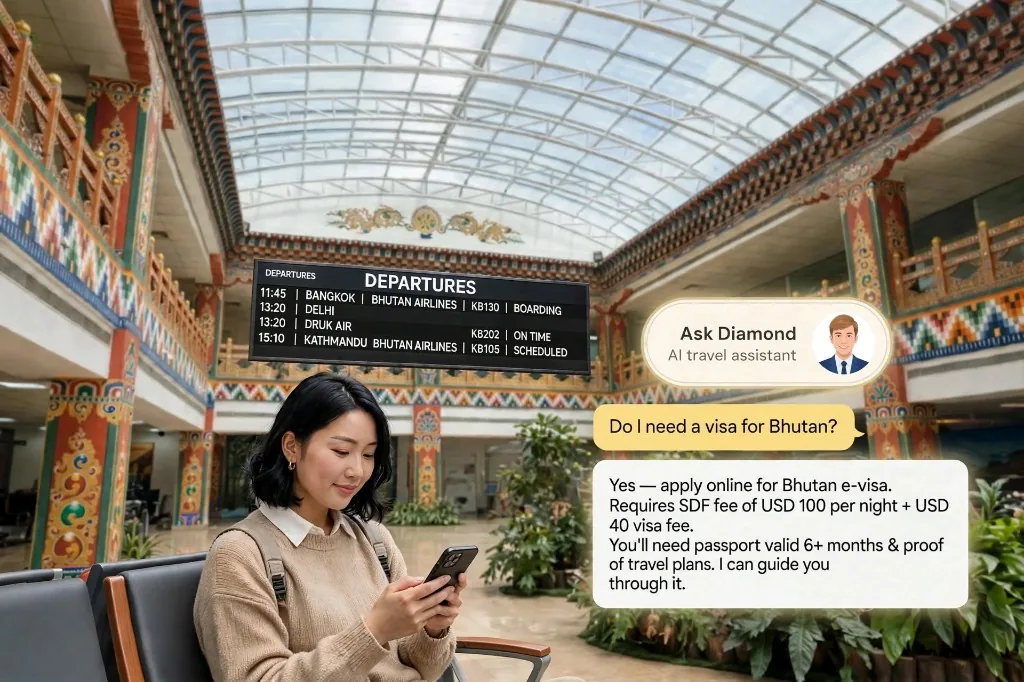
A few months ago I wrote about how we built this website in-house with the help of AI. This is the sequel. It is the story of Diamond, the assistant in the corner of every page, which our team at OMG Experience built together with Sai Teja Vaidya.
The short version: the site worked, enquiries grew, and we needed a way to answer the same good questions at any hour without making anyone wait. Diamond is how we did that.
Where it started

I met Sai at a Cursor meetup, the one known as the Grok Bot Meetup, back before the SpaceX acquisition. Sai is an Applied AI Engineer who works on AI agents and agentic workflows, and what stood out was curiosity rather than buzzwords. He wanted to try his ideas on a real business with real customers.
He has been with us for the past few months, and Diamond is the first thing we have built together. Our team brought what we know best: our customers and the questions they ask us every day. Sai helped us turn that into an assistant. The same assistant now runs on the websites across our group of companies, not just this one.
One rule from day one
We agreed on one rule before anything else, and it has not changed. Diamond should never answer from whatever it happens to know about the internet. It should find what our own website says about the question, answer only from that, and show which pages it used. For an airline sales agent, a confident wrong answer about a fare or a visa is worse than no answer at all.
From first try to part of the website
The first version proved the idea, but it ran on its own, apart from the rest of our website. That meant one more thing to look after. So we rebuilt it, again with the help of AI, to run as part of the same setup as our website and enquiry forms. It costs almost nothing when nobody is chatting, and it keeps up on its own when a lot of people are.
Rebuilding it was also a chance to polish it. We tried it against the questions our team really gets, fixed the answers that picked a less helpful page, and added automatic checks so those fixes stay fixed.
How Diamond answers a question
Every time we update the website, Diamond reads it again, including the latest fares, flight times and travel articles. So what Diamond knows is exactly what the website says, no more and no less.
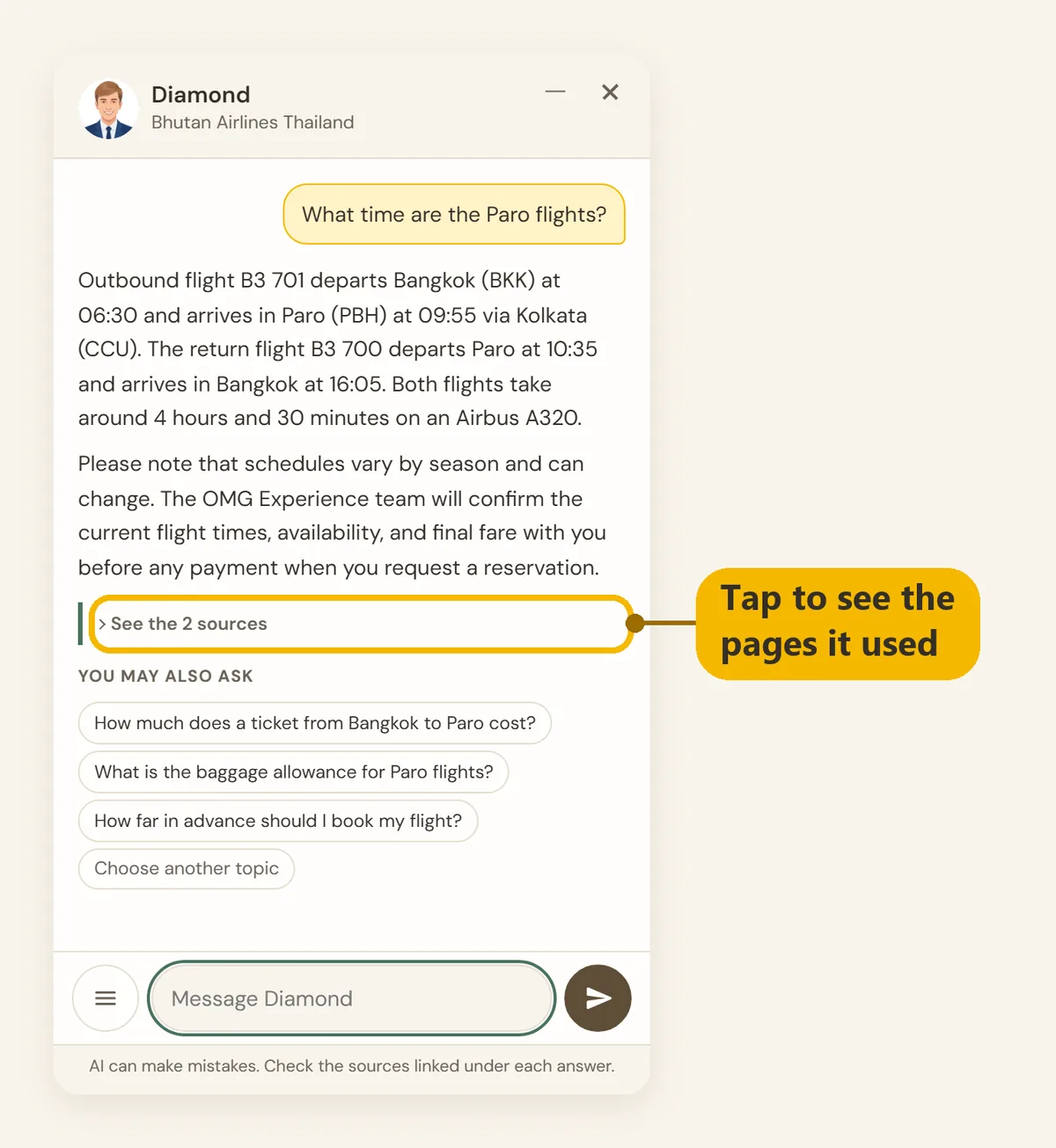
When you ask something, Diamond looks for the parts of the website that best match your question, writes a short answer from those alone, in the language you used, and lists the pages it used so you can check for yourself.
Knowing its limits
Diamond follows a short list of fixed rules. It never makes up fares, schedules or availability. It never says a seat is held or a booking is made. It never asks for card numbers or passport details, and it cannot see existing bookings, so those questions go straight to our team.
Knowing when to stop is the other half of the job. When a question needs a quote, involves a group, or goes beyond what the website covers, Diamond says so and offers a way through: a button to call our office, or a short form inside the chat. Those forms reach the same team that handles every other enquiry, so nothing falls between the two.
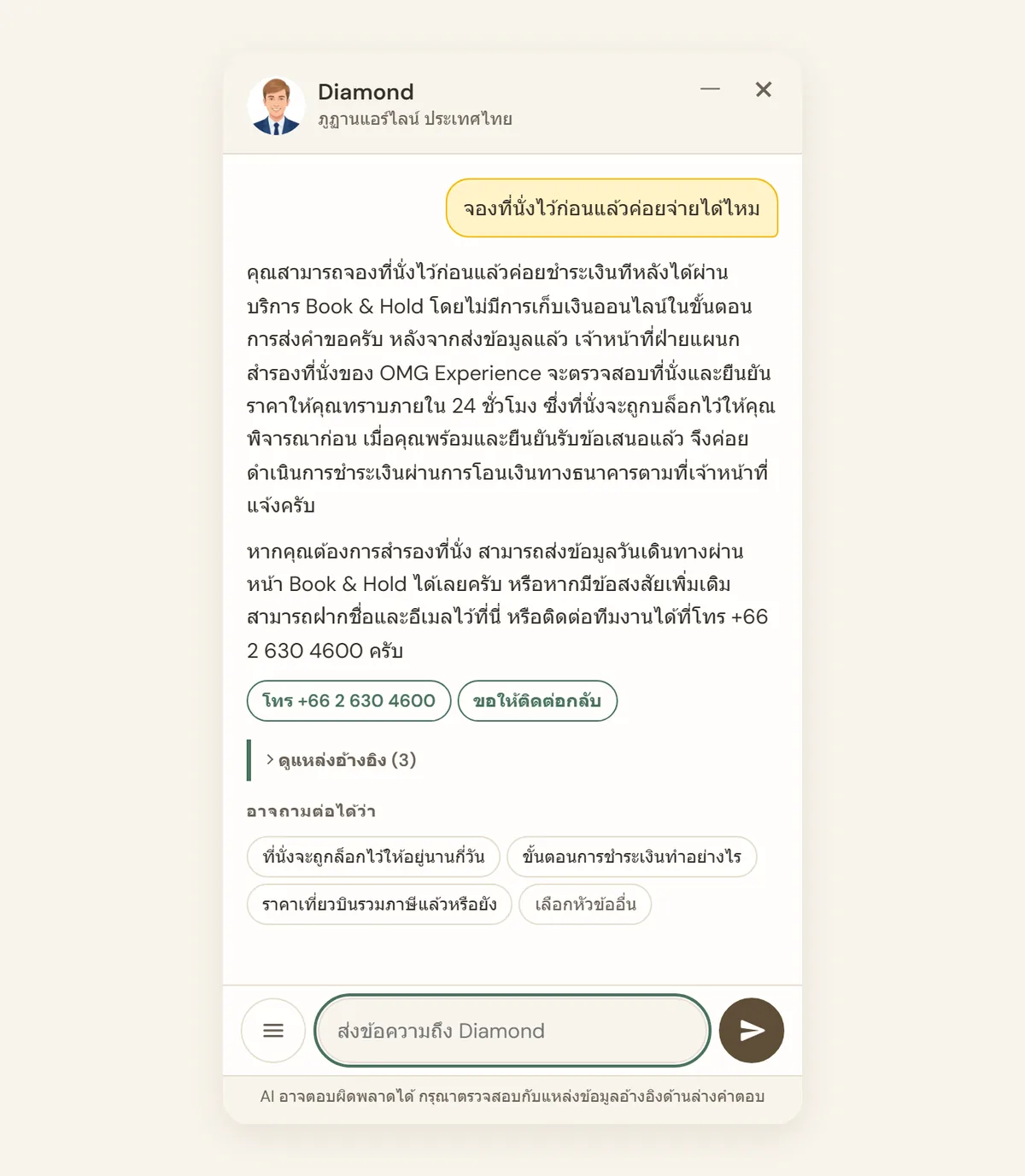
Diamond speaks Thai and English and answers in whichever language you use. Our team can change its name, picture and opening line, switch it off, and read what visitors are asking, which has quietly become one of our best sources of ideas for what the website should explain better.
What real phones taught us
As with the website, the lessons came from real devices. On a phone the chat opens full screen, and an early version reopened itself on every new page after you had minimised it. It now remembers your choice. Long lists of sources pushed the answer off the screen, so they now sit behind a single tap. Small things, but they are the difference between a helper and an interruption.
What I would tell you
Diamond is not impressive because it uses AI. Everyone uses AI now. It is useful because it is focused: it only knows what we publish, it shows its sources, and it knows when to hand over to a person. Building it together, with our team's know-how and Sai's help, is what kept it that way.
And if you would rather talk to a person, you still can. Diamond is named after a real member of our team, and he is at our office. Call us on +66 2 630 4600.
To try it, open any page and look for Ask Diamond in the bottom right corner. To read how the website itself was made, see how we built this site.